
Cell. 2020 Mar 5;180(5):984-1001.e22.
Caloric聽Restriction聽Reprograms聽the聽Single-Cell Transcriptional聽Landscape聽of
Rattus聽Norvegicus聽Aging
Ma S 1,Sun S 2, Geng L 3,聽Song M 4,聽Wang W 5,聽Ye Y 6,聽Ji Q 5,聽Zou Z 5,聽Wang S 7,聽He X 8,聽Li W 8,聽Esteban CR 9,聽Long X 10,聽Guo G 11,聽Chan P 8,聽Zhou Q 12,聽Belmonte JCI 13,聽Zhang W 14,聽Qu J 15,聽Liu GH 16
- 1 State Key Laboratory of Membrane Biology, Institute of Zoology, Chinese Academy of Sciences, Beijing 100101, China; National Laboratory of Biomacromolecules, CAS Center for Excellence in Biomacromolecules, Institute of Biophysics, Chinese Academy of Sciences, Beijing 100101, China.
- 2 National Laboratory of Biomacromolecules, CAS Center for Excellence in Biomacromolecules, Institute of Biophysics, Chinese Academy of Sciences, Beijing 100101, China.
- 3 State Key Laboratory of Stem Cell and Reproductive Biology, Institute of Zoology, Chinese Academy of Sciences, Beijing 100101, China; Advanced Innovation Center for Human Brain Protection, and National Clinical Research Center for Geriatric Disorders, Xuanwu Hospital Capital Medical University, Beijing 100053, China.
- 4 State Key Laboratory of Membrane Biology, Institute of Zoology, Chinese Academy of Sciences, Beijing 100101, China; Institute for Stem Cell and Regeneration, Chinese Academy of Sciences, Beijing 100101, China; University of Chinese Academy of Sciences, Beijing 100049, China.
- 5 State Key Laboratory of Membrane Biology, Institute of Zoology, Chinese Academy of Sciences, Beijing 100101, China; University of Chinese Academy of Sciences, Beijing 100049, China.
- 6 State Key Laboratory of Stem Cell and Reproductive Biology, Institute of Zoology, Chinese Academy of Sciences, Beijing 100101, China; Institute for Stem Cell and Regeneration, Chinese Academy of Sciences, Beijing 100101, China.
- 7 State Key Laboratory of Membrane Biology, Institute of Zoology, Chinese Academy of Sciences, Beijing 100101, China; Advanced Innovation Center for Human Brain Protection, and National Clinical Research Center for Geriatric Disorders, Xuanwu Hospital Capital Medical University, Beijing 100053, China; Institute for Stem Cell and Regeneration, Chinese Academy of Sciences, Beijing 100101, China.
- 8 Advanced Innovation Center for Human Brain Protection, and National Clinical Research Center for Geriatric Disorders, Xuanwu Hospital Capital Medical University, Beijing 100053, China.
- 9 Gene Expression Laboratory, Salk Institute for Biological Studies, La Jolla, CA, USA.
- 10 Division of Plastic Surgery, Peking Union Medical College Hospital, Beijing 100032, China.
- 11 Center for Stem Cell and Regenerative Medicine, Zhejiang University School of Medicine, Hangzhou 310058, China.
- 12 State Key Laboratory of Stem Cell and Reproductive Biology, Institute of Zoology, Chinese Academy of Sciences, Beijing 100101, China; Institute for Stem Cell and Regeneration, Chinese Academy of Sciences, Beijing 100101, China; University of Chinese Academy of Sciences, Beijing 100049, China.
- 13 Gene Expression Laboratory, Salk Institute for Biological Studies, La Jolla, CA, USA. Electronic address: belmonte@salk.edu.
- 14 Advanced Innovation Center for Human Brain Protection, and National Clinical Research Center for Geriatric Disorders, Xuanwu Hospital Capital Medical University, Beijing 100053, China; Institute for Stem Cell and Regeneration, Chinese Academy of Sciences, Beijing 100101, China; University of Chinese Academy of Sciences, Beijing 100049, China; Disease Genomics and Individualized Medicine Laboratory, Beijing Institute of Genomics, Chinese Academy of Sciences, Beijing 100101, China; China National Center for Bioinformation, Beijing 100101, China. Electronic address: zhangwq@big.ac.cn.
- 15 State Key Laboratory of Stem Cell and Reproductive Biology, Institute of Zoology, Chinese Academy of Sciences, Beijing 100101, China; Institute for Stem Cell and Regeneration, Chinese Academy of Sciences, Beijing 100101, China; University of Chinese Academy of Sciences, Beijing 100049, China. Electronic address: qujing@ioz.ac.cn.
- 16 State Key Laboratory of Membrane Biology, Institute of Zoology, Chinese Academy of Sciences, Beijing 100101, China; National Laboratory of Biomacromolecules, CAS Center for Excellence in Biomacromolecules, Institute of Biophysics, Chinese Academy of Sciences, Beijing 100101, China; Advanced Innovation Center for Human Brain Protection, and National Clinical Research Center for Geriatric Disorders, Xuanwu Hospital Capital Medical University, Beijing 100053, China; Institute for Stem Cell and Regeneration, Chinese Academy of Sciences, Beijing 100101, China; University of Chinese Academy of Sciences, Beijing 100049, China. Electronic address: ghliu@ioz.ac.cn."
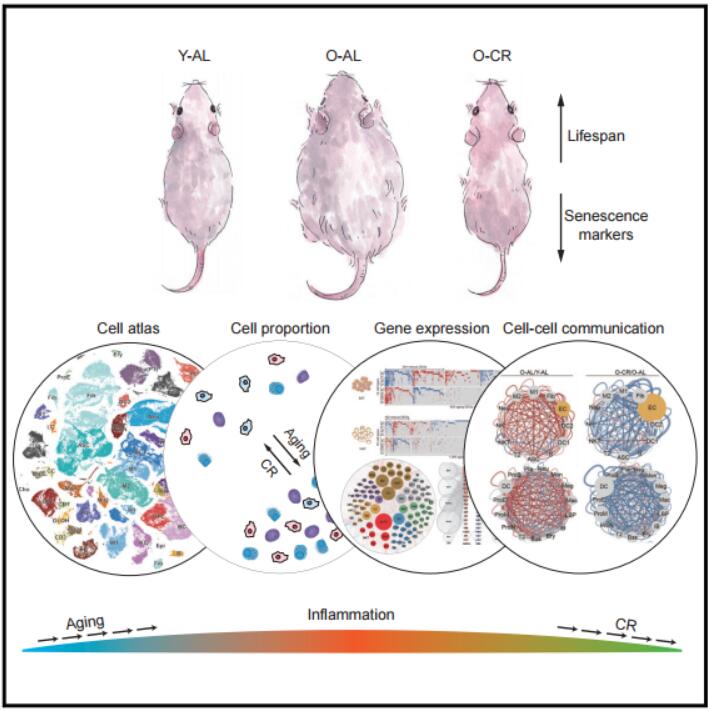
Aging causes a functional decline in tissues throughout the body that may be delayed by caloric restriction (CR). However, the cellular profiles and signatures of aging, as well as those ameliorated by CR, remain unclear. Here, we built comprehensive single-cell and single-nucleus transcriptomic atlases across various rat tissues undergoing aging and CR. CR attenuated aging-related changes in cell type composition, gene expression, and core transcriptional regulatory networks. Immune cells were increased during aging, and CR favorably reversed the aging-disturbed immune ecosystem. Computational prediction revealed that the abnormal cell-cell communication patterns observed during aging, including the excessive proinflammatory ligand-receptor interplay, were reversed by CR. Our work provides multi-tissue single-cell transcriptional landscapes associated with aging and CR in a mammal, enhances our understanding of the robustness of CR as a geroprotective intervention, and uncovers how metabolic intervention can act upon the immune system to modify the process of aging.
view this paper in scRNA-Seq database